





Love crosses borders every day. In my chair, I see couples who fell for each other across time zones, accents, and rulebooks. The truth is both simple and deep: cross-border love can shine, and it can strain. In this guide I’ll lay out the pros and cons of marrying someone from another country, share what I see in long-term work with couples, and give you exercises you can start this week. We’ll also look at what research says about satisfaction and stress in intercultural pairs. Bring your curiosity. Leave room for both of your stories.
What I’ve Seen Working With International Couples
I’m pro-love and pro-safety. Cross-border pairs can build steady homes full of warmth, humor, and shared pride. They often carry a wider circle—two languages, two kitchens, two sets of elders. When the bond grows on respect, the house feels rich, not crowded.
Do they face extra stress? Yes. Paperwork, long waits, and money choices can press hard. But when couples use clear roles, weekly rituals, and fair repair steps, the stress bends rather than breaks. A candle on Friday night. A Sunday call to both mothers. A budget chat that takes 20 minutes. Small rhythm, big payoff. Evidence backs the link between meaningful rituals and couple satisfaction.
I keep a calm stance in session: curiosity beats correctness. If your partner’s way feels “wrong,” chances are it means “respect” in their rulebook. Cultural differences aren’t bugs; they’re codes. Research on “tight” vs. “loose” cultures and on individualism vs. kin duty helps translate fights into sense.
Across cases, one more theme repeats: love is not weaker across cultures. Meta-analyses find no broad drop in satisfaction for intercultural couples compared with same-culture couples. Skills and support matter more than passports.
“Culture isn’t a wall. It’s a language. Learn the few words that matter most.”
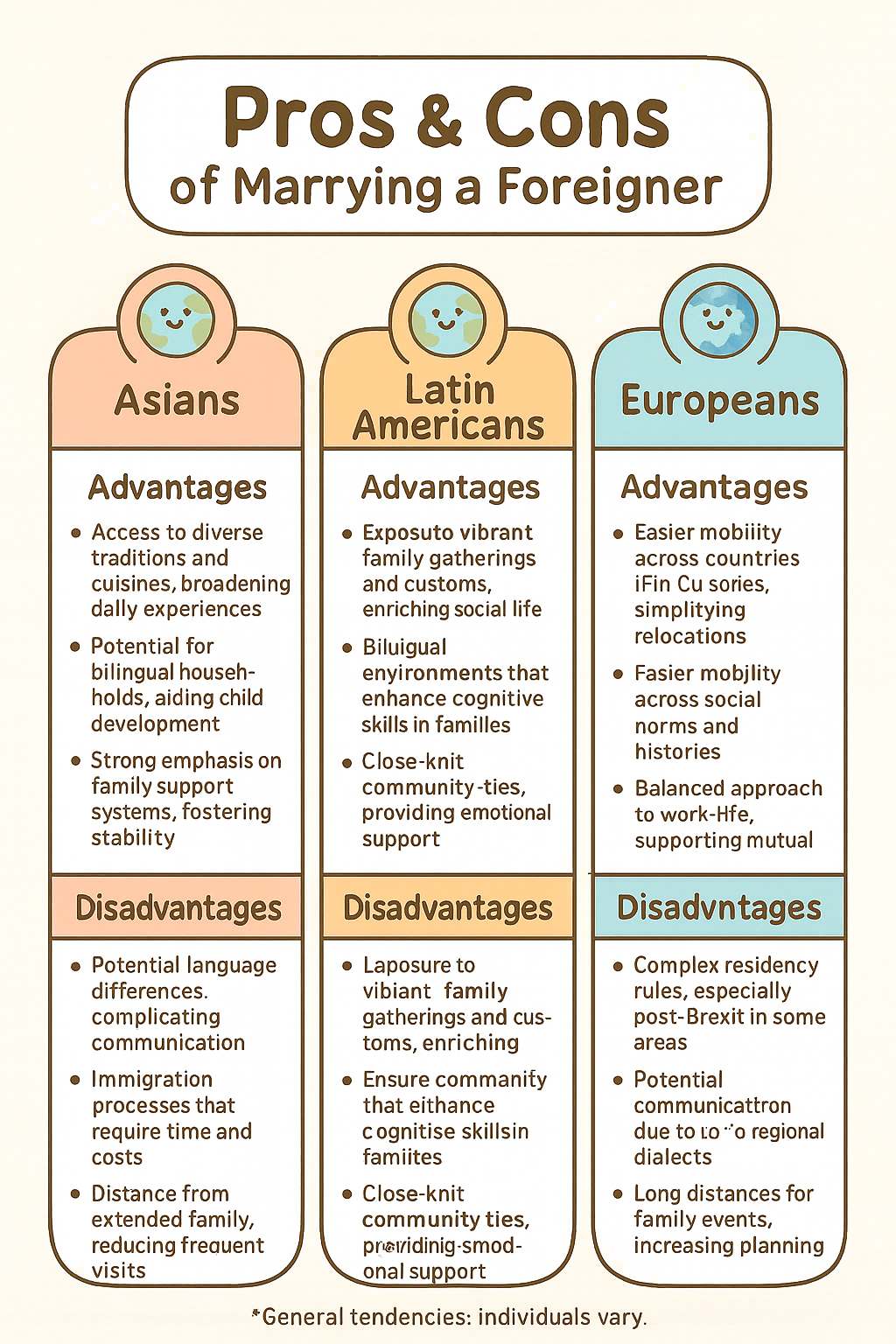
The Pros and Cons of Marrying Someone from Another Country
Quick note: Every couple is different. The points below describe patterns I see most often. Use what fits, toss what doesn’t.
Pro 1: A Bigger Story to Share
You don’t just add a spouse—you add a world. Food, humor, songs, holy days, and new nephews. Couples who mark these on a joint calendar tend to feel proud of “us,” not stuck at “me vs. you.” A large body of research ties family rituals with higher marital satisfaction. Start small: one weekly ritual you keep, one you adapt, one you create.
Try this mini-list:
- Keep: Friday dinner with a short blessing.
- Adapt: Your partner’s holiday, moved to Saturday so both families can join.
- Create: First-Sunday soup night, phones in a bowl.
Pro 2: More Empathy, Less Assumption
Different rulebooks force you to ask, not assume. You practice “What does this mean to you?” This habit lowers blame and quickens repair. In tight-culture/loose-culture pairs, empathy turns “you’re rude” into “you value direct truth” or “you value harmony.” That shift calms fights.
Two-line script:
- “In my family, silence showed respect.”
- “In mine, silence felt chilly. Can we set a ‘pause word’ and a return time?”
Pro 3: Wider Support Network
Two families can mean more help with childcare, illness, and holidays. Yes, coordination takes work. The upside is real—a larger safety net and shared wisdom from elders.
Divide and prosper:
- You handle flight deals for family visits.
- Your partner handles guest room plans and meals.
- Rotate whose parents get the long holiday.
Pro 4: Growth for Kids (if you choose to have them)
Bilingual kids tend to gain flexible thinking and stronger ties to grandparents. The home becomes a living classroom. Label the house in both languages. Keep a weekly “story from your childhood” circle.
Pro 5: Fresh Adventure Without the Chaos
You get novelty with an anchor—new recipes, road trips to heritage towns, local festivals—inside the same marriage. Many couples report higher shared meaning when they build these micro-adventures into the month.
Pro 6: Stronger Skills Under Stress
Paperwork, interviews, and distance demand planning, patience, and teamwork. Couples who survive the bureaucracy often enter into marriage with established habits for solving problems. Therapy research supports structured repair across models.
Pro 7: A Check on Your Biases
You catch blind spots—about gender, money, in-law duty, and time. That self-awareness can lift the whole relationship.
Pro 8: Better Boundaries With In-Laws (Yes, Really)
When cultures differ, couples often set rules early—how often to visit, what counts as privacy, who decides bedtime for kids. Clear rules feel kind to everyone.
Pro 9: Flexibility With Money
You might send remittances to parents, you might not. You might pool funds, keep some separate, or use a hybrid. Talking about money sooner keeps trust high.
Three fair models:
- Equal share to joint costs.
- Proportional to income.
- Pooled with personal allowances.
Pro 10: Shared Pride in a Hard Thing Done Well
You faced systems and kept each other first. That story becomes a quiet strength in tough years.
Con 1: Bureaucracy Can Wear You Down
Visas, apostilles, and long queues test even steady pairs. You will repeat forms and wait on replies. This grind can widen small cracks.
Counter-moves (checklist):
- A shared cloud folder with IDs, dates, receipts.
- A monthly “paperwork hour,” timer on, tea ready.
- A code word when the stress hijacks the night: “Pause, not panic.”
Con 2: Misread Signals in Daily Life
Direct speech in one culture can land harsh in another. Indirect speech in one can feel evasive in another. Tight/loose gaps add friction over rules, punctuality, clothes, and “the right way.” Knowing the research won’t fix it, yet it helps name the clash.
Translation game:
Each partner lists three “This means respect” habits. Trade lists. Pick one to honor this week.
Con 3: Distance From One Family (and Guilt)
Someone lives far from home. Missed weddings, empty seats at birthdays, time-zone grief. Plan care on purpose or resentment grows.
Small list for long-distance care:
- Weekly video with elders, same day and time.
- Photo drop from the week, no captions required.
- A budget line for flights every 12–18 months if possible.
Can You Really Overcome Your Differences?
Yes—when you treat difference as meaning, not malice. I’ve watched pairs move from “You’re wrong” to “You were taught X, I was taught Y, let’s build Z.” They stop scoring points and start swapping maps. That is the real fix.
A few pillars help. First, rituals—small, regular moves that say “we.” Research links family rituals with marital satisfaction, even when beliefs differ. Second, repair skills—short scripts for the rough days. Couple-therapy reviews show that skills you practice under guidance can stick and help at home. Third, language for culture—terms like tight/loose remind you that style is not sin.
Will every pair make it? No. But the pros and cons of marrying someone from another country tilt to “workable” when you keep respect high and pace steady. The couples who last mix kindness with clear lines.
“We don’t erase your histories. We weave them.”
Exercises You Can Start This Week
The Rulebook Swap (20 minutes)
Each of you answers three prompts on paper:
- “Respect looks like…”
- “A good fight looks like…”
- “Family time means…”
Swap papers. Circle one item from your partner’s list to honor this week. Circle one from your list to let go for now.
Tight–Loose Map (15 minutes)
Draw a line from tight to loose. Mark where each of you sits on: time, rules, dress, talk in conflict. Pick one zone to move one notch to each other. Cite the change in the calendar: “On Sundays we leave at 12:40, not ‘around one.’” Research backs the usefulness of naming tight/loose differences.
The 5-5 Repair
After a flare-up, set five minutes each. Person A: one regret, one need. Person B: reflect what you heard, then one regret, one need. End with one tiny next step. Couple-therapy evidence supports structured repair tools across models.
Keep–Adapt–Create (Ritual Builder)
Make a three-column table. Fill it with weekly and yearly rituals. Keep one from each family, adapt one, create one. Research has tied rituals with higher satisfaction.
Money Huddle (30 minutes)
Agenda: values (5), numbers (10), roles (10), review date (5). Choose a fair model. No shaming. Put the next check-in on the calendar.
In-Law Door-In/Door-Out Plan
Decide the door-in times (when family is warmly invited) and door-out times (couple privacy). Write two sample texts to use when boundaries need a gentle reminder.
What Research and Experience Say About Success
Data do not show a blanket penalty for intercultural pairs. A 2022 meta-analysis reviewing diverse-background couples versus same-culture couples found no overall drop in relationship satisfaction for mixed-culture pairs. The authors argue that communication, support, and meaning—not cultural difference alone—drive outcomes. A 2024 scoping review echoes that the field should stop assuming lower satisfaction for intercultural couples and look instead at the real moderators: stress load, social support, and skills.
Meanwhile, key couple skills help across the board. Reviews of couple therapy in the 2020s show strong empirical support for structured methods, and recent meta-analyses of Emotionally Focused Therapy show solid gains and durability for many couples. Finally, rituals keep bonds steady; classic work by Fiese and colleagues links family rituals—including religious holiday practices—with higher marital satisfaction.
Put plain: if you work the basics—interesting questions, fair money, weekly rituals, clean repair—the pros and cons of marrying someone from another country look less like fate and more like a set of choices you can make together.
When Bureaucracy Tests the Bond: Holding Steady Through the Wait
Paperwork can feel like a third person in the marriage. Forms, fees, appointments, and long silences from offices can drain even patient couples. I often say, “The system moves on its own clock. Your job is to protect morale.” That means short goals you can hit this week and clear rituals that remind you why you chose each other.
Set two tracks. Track A is the visa plan with dates and tasks. Track B is the care plan that keeps the heart warm while you wait. I ask couples to pick one small anchor per day—tea at 9 p.m., a short prayer, a five-minute voice note—and one shared block per week. The day you submit a form, celebrate with something ordinary and kind. Let the body store a good memory next to a hard task.
Name the feelings without blame. Fear shows up as control. Sadness shows up as sleep. Irritability often hides worry about money or parents. When you can say, “I feel scared; I need a timeline,” you lower the heat and raise the odds of a calm fix. Use a whiteboard or a shared doc so both can see the plan without hunting through chats.
Finally, tell one trusted friend in each country what you are facing. Isolation doubles stress. Warm witnesses cut it in half. You do not need advice every time; you need a person who says, “I see you. Keep going.” That small sentence helps you carry the real pros and cons of marrying someone from another country with more ease.
Green Flags and Red Flags You Can Spot Early
Use this quick list before each step—first call, first trip, first big ask. One honest check can save months of hurt.
- ✅ Pace matches the slower partner. No rush for vows, no sulking when you ask for time.
- ✅ Video first, public meet-ups next. Identity checks feel normal, not rude.
- ✅ Stories stay consistent. Work, family, and daily life line up over weeks.
- ✅ Fair money rules. Each pays what fits the plan; no guilt, no leverage.
- ✅ Curiosity both ways. You learn each other’s rulebooks about respect, time, and faith.
- ✅ Friends and family exist. You meet real people in their circle, at least online.
- 🚩 Fast declarations + secrecy. “Soulmate” on day three, yet no video or public meeting.
- 🚩 Money talk appears early. “Emergency,” “investment,” gift cards, or crypto.
- 🚩 Shame as pressure. “If you loved me, you would…”
- 🚩 Immigration used as bait. Promises tied to obedience or silence.
- 🚩 You feel smaller over time. Jokes that cut, rules that only bind you.
Mary’s rule: if three red flags show up, pause the romance and protect yourself. Love can wait. Safety cannot.
Five Conversations Every Cross-Border Couple Needs in Year One
You won’t solve everything in a week. You can set solid ground. Use these talks in any order. Keep them short and kind. End with one written step.
1) “Respect Looks Like…”
Trade three examples from childhood and three from adult life. Maybe respect meant quiet at dinner, or it meant a loud debate that ended with a hug. Pick one habit from your partner’s list to honor this month. Pick one from your list to relax for now. This turns “you’re wrong” into “we come from different maps.”
2) Money and Help for Parents
Share numbers and values before you talk tactics. Decide the model—equal, proportional, or pooled with allowances. Add one clear line for family support if that applies. Put the next budget huddle on the calendar. A fair plan beats a perfect plan.
3) Holidays and Holy Days
Open a big calendar. Mark must-keep dates from both sides. Choose one to keep as is, one to adapt, one to create together. Send the plan to parents a month ahead. That one email can prevent five fights.
4) Conflict Style and Repair
Name your two default moves. Maybe you go loud, your partner goes quiet. Agree on a time-out rule (20–30 minutes), a return time, and a two-line script: “My regret is ___; my ask is ___.” Keep voices low and bodies close. Practice on small stuff first.
5) Home Base and Future Moves
Where will you live this year? Next year? What does “home” mean? List the real drivers: work, health care, schools, elder needs, visas. Circle the top two. Decide one experiment—a three-month trial in one city or a “living apart together” season if that fits. Revisit in 90 days.
“Simple, steady talks beat one big talk that leaves both of you wrung out,” I tell couples. These five cut across the pros and cons of marrying someone from another country and give you footing you can trust.
Conclusion
The pros and cons of marrying someone from another country are real, yet they are not a verdict. Culture shapes you; it does not trap you. If you slow down, learn each other’s rulebooks, and practice small, steady rituals and repairs, you can build a home that feels fair and warm to both of you. Start with one exercise this week—the Rulebook Swap or the Money Huddle—and see what opens.
Want help mapping your 4-week plan? Book a consultation. We’ll sketch simple steps that fit your life and protect your bond.
FAQs
Is cultural difference the main reason couples fail?
No. The heaviest risks come from chronic stress, poor repair skills, and lack of support. Intercultural couples can be as satisfied as same-culture couples.
Do shared rituals really help?
Yes. Decades of research link family rituals with higher marital satisfaction and better adjustment. Keep one, adapt one, create one.
We fight about time and rules. Can that change?
Often. Tight/loose differences are common. Name the gap, then set one clear standard per week.
Does therapy help cross-border couples?
Yes. Reviews show strong support for structured couple therapy; EFT has robust evidence.
How common are marriages across differences today?
In the U.S., interfaith and interracial marriages are a steady share of unions, and tolerance for mixed ties continues to grow in many groups. See recent Pew reports for details.
Sources & Further Reading
- Pew Research Center (2025). Religious intermarriage. (Pew Research Center)
- Pew Research Center (topic hub). Intermarriage trends (race/ethnicity). (Pew Research Center)
- Gelfand, M. J., et al. (2011). Tight vs. loose cultures. Science/PubMed summary. (PubMed)
- Fiese, B. H., et al. (2002). Family routines and rituals review. Journal of Family Psychology. (apa.org)
- Fiese, B. H., et al. (2001). Religious holiday rituals & marital satisfaction. (PubMed)
- Uhlich, M., et al. (2022). Cultural diversity within couples: meta-analysis. (Wiley Online Library)
- Henderson, E. K., et al. (2021). Cross-group relationship satisfaction meta-analysis. (Tandfonline)
- Lebow, J. (2022). Couple therapy in the 2020s (review). (PMC)
- ICEEFT (2024). EFT research page, meta-analysis summary. (iceeft.com)