





Love crosses borders every day. As a couples therapist with 30+ years in the chair, I’ve seen how two people from different countries build a steady life together. The steps feel big, yet they are doable with clarity, patience, and good help. In this guide I’ll show you the path from first hello to legal vows, answer the “Is it legal?” question in plain terms, share real case stories from my practice, and give practical tools you can use this week. If you’re marrying someone from a different country, this is for you.
What I Think About International Relationships
I hold a very positive view. Across thousands of sessions, I’ve watched cross-border couples build stable, warm homes. They add languages, food, rituals, and humor. They also add courage. You learn to ask better questions and to slow your tone so your partner feels safe. That makes any marriage stronger.
I don’t treat “cultural differences” like a problem. I treat them like a set of meanings that deserve care. When a couple frames a difference as meaning rather than a fight, the room softens. We get curious, not defensive. That shift changes outcomes.
I also respect the extra work these couples carry. Paperwork, time zones, family opinions, money trade-offs, long waits at borders. I say this often in my office: You’re not “too much.” The task is heavy. We break tasks down, we build a rhythm, we protect your bond while the system moves at its own pace.
My stance in one line: Curiosity beats correctness. If you can hold two truths—your family’s way and your partner’s way—you will form a third way that fits your life. You don’t need to erase anyone’s story to form a new one.
“Culture isn’t a wall in marriage. It’s a language. Learn the words that matter.”
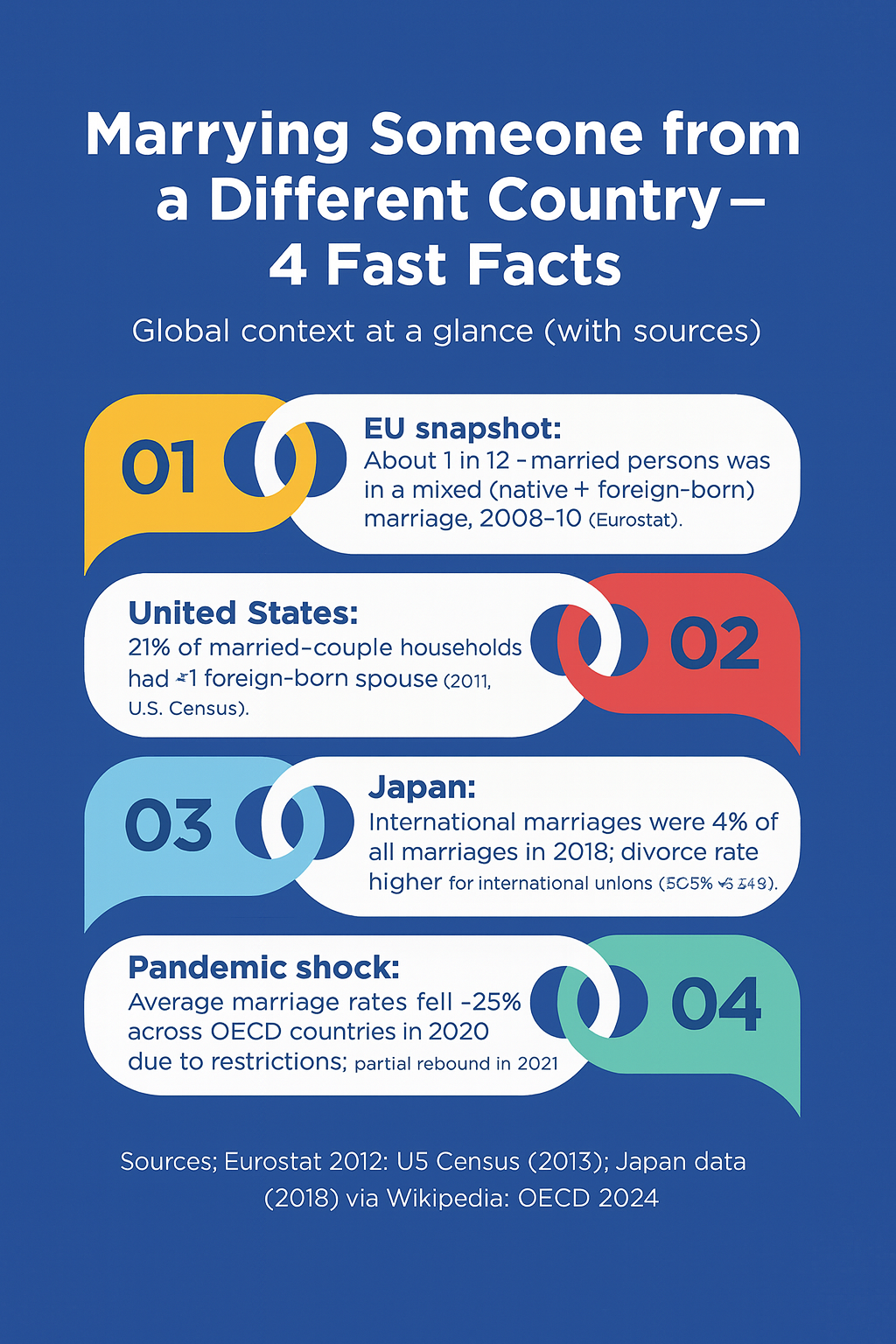
International Marriage Statistics
The Process of Marrying Someone from a Different Country
Every country has its own rules. The steps below outline the usual flow. I’ll add examples from the U.S., U.K., and EU to make it concrete and real.
1) Set intentions and basic safety
Start with a clear joint goal: friendship first, then trust, then plans. If you met online, that’s normal. Many long-term pairs start on apps or sites now. Good data shows online meeting rose fast in the past decade, and a large share of couples report they met that way.
Stay scam-aware from day one: no money to new contacts, no crypto “investments,” no gift cards for “emergencies.” Romance scams cost people large sums, with U.S. agencies reporting losses over $1 billion in recent years. If a request for money appears, pause and verify. Report fraud to the FBI’s IC3.
2) Build trust across distance
Use steady calls, video, and a shared calendar. Swap real-life details: friends, work, daily routines. Trust grows when words match actions over time. If language differs, keep sentences short. Ask the “why” behind customs and rules at home. That “why” carries the heart of the bond.
3) Plan the first visits and meet the families
Travel both ways when possible. Host your partner with the same care you hope to receive. Share your “house rules” before the visit. Ask parents what respect looks like at their table. Small gestures—shoes at the door, a quick hello call—carry weight.
4) Get your documents in order
You will need valid passports and civil records (birth certificate, proof a past marriage ended if that applies). Many countries require certified translations and, if the document crosses borders, an apostille or other authentication so officials abroad accept it. For countries that signed the Hague Apostille Convention, an apostille certifies the origin of a public document used abroad.
5) Decide where to marry: abroad or in your home country
If you wed abroad, you must meet the local rules for marriage. That may include residency periods, specific affidavits, or local civil/religious officiants. U.S. guidance for citizens marrying abroad states that marriages done abroad are valid in that country if they follow local law; recognition elsewhere depends on each country’s law. Examples include residency windows and proof of eligibility to marry.
Some couples do a small civil wedding at home first, then hold a symbolic ceremony abroad to avoid complex paperwork. That path is common and lawful when each step follows the right local rules.
6) Understand visa paths with real examples
Visa names vary by country. Here are illustrative routes—rules change, so always check official sites.
- United States, fiancé path (K-1): A U.S. citizen files Form I-129F. If granted, the foreign fiancé enters on a K-1 visa and the couple must marry within 90 days, then apply for status after the wedding.
- United States, spouse path (IR-1/CR-1): If already married, the U.S. sponsor files an I-130; the case moves through the National Visa Center, then to a visa interview. A spouse arrives as a permanent resident if approved.
- United Kingdom, partner visa: A partner of a British or settled person can apply if age, relationship, income, English, and other checks are met. The official site explains who qualifies and when you can switch visas.
- European Union, family reunification: For non-EU spouses of legal residents, the EU Family Reunification Directive sets common rules; details vary by country. For EU citizens, the “free movement” rules give spouses rights, with national procedures for proof
Important: thresholds for income, language, and timelines can change. Always read current government pages before you act. Policy debates in places like the U.K. can shift requirements.
7) Health checks, finances, and legal prep
Some countries ask for medical certificates, age checks, or additional records. You will also face money questions: who pays what, how you’ll budget across currencies, whether you will support parents with remittances. Book one hour for a budget talk each month. Bring net income, fixed costs, savings goals, and a fair split model. If you want a prenup or marital contract, hire counsel in the country that will govern your life.
8) Ceremony and ritual design across cultures
Pick one ritual from each home you will keep as is. Pick one you will tweak. Create one that is just yours. Write it down. Share the plan with the families early so no one is caught off guard.
9) After the wedding: status and records
Register the marriage in the country that needs a record for immigration. If you married abroad and will live elsewhere, ask what proof the new country needs. This is where apostille or legalization steps often show up again. Start status updates on time and keep copies of everything.
10) Build your shared rhythm
When the papers settle, your daily rhythm matters most. Keep one weekly ritual that holds you together. Host both families during the year with a simple plan. Set a quarterly “relationship review” date to check in on money, in-law time, holidays, sex, and stress.
Is Marrying Someone From a Different Country Legal?
Short answer: Yes—but your marriage must meet the local rules where the ceremony happens and the immigration rules where you plan to live.
- Marriage law is local. If you marry in a foreign country, that marriage is valid there if you followed that country’s law. Recognition elsewhere depends on each country’s own rules. U.S. guidance says consular staff cannot marry you; local civil or religious officials do that, subject to local law.
- Documents must be accepted abroad. Many countries require an apostille for cross-border use of public records. If a country is not part of the Hague system, full legalization may be needed.
- Immigration is separate from marriage. A legal marriage does not grant a visa by itself. You still apply through the right path in the country where you will live, like a U.S. K-1 or IR-1/CR-1, a U.K. partner visa, or EU family reunification routes.
Case Studies From My Practice
Names and details changed.
Case 1 — Long-distance trust and a K-1 timeline
Ana (Peru) and Michael (U.S.) met on a language exchange site. They set a weekly video dinner to share real life, not just text. After nine months and two visits both ways, they filed a K-1 petition. The wait tested them. We built a “two-track plan”: Track A was paperwork steps; Track B was care steps—Sunday calls with both moms, monthly budget chats, and a shared folder for visa proof. Their phrase for stress was, “Bureaucracy is slow; love stays steady.” When the visa came, they already had a rhythm at home.
Case 2 — Two families, one calendar
Elif (Türkiye) and Jonah (U.K.) kept clashing on holiday plans. His parents wanted Christmas at their place; her parents wanted Bayram with a big meal and cousins. We drew a 12-month wall calendar and marked three tiers: Keep (non-negotiable), Rotate (alternate years), Host (bring both sides together). They added one “just us” weekend each quarter. The calendar reduced last-minute stress, and both families felt respected.
Case 3 — Money to parents vs. savings
Ivy (Philippines) sent money home each month. Daniel (Canada) felt anxious about their own goals. We used a values-first budget: 10 minutes naming what mattered, then numbers. They set a fixed family support line, then split joint bills proportionally to income. Anxiety dropped once money had a clear shape.
Case 4 — In-law privacy and small homes
Chen and Li lived near his parents in a small flat. Pop-ins sparked fights. We wrote a door-in/door-out plan: a standing Sunday tea with parents; a “text first” rule at other times; one open invite per month that the couple could accept or decline without pressure. Tone softened on both sides.
Case 5 — After the wedding, the blues
Marta moved to her wife’s country and left a tight friend circle. The house felt quiet; language class felt hard. We added two anchors: a weekly group for newcomers and a Sunday video with friends back home. We named the mood as grief, not a personal flaw. That honest label helped a lot.
Psychological Advice: How to Make an International Marriage Work
These ideas come from experts on how to build a good life together across borders. They focus on clear talks, daily habits, and fair rules.
- Say the rulebook out loud. “In my family, a quick call to Mom shows respect.” Then ask, “What shows respect in yours?”
- Pick weekly rituals. One small ritual beats grand plans. Tea at 9 pm. A prayer. A walk after dinner.
- Agree on a money script. Decide whether you pool funds, keep separate, or use a hybrid. Review on the first Sunday monthly.
- Set language goals. If one partner speaks the host country’s language, be the coach, not the critic. If both need classes, schedule them side by side.
- Keep a shared calendar. Mark fasts, feasts, school breaks, visa dates, and bill due dates.
- Use short repair steps. Name one regret and one request after a fight.
- Protect in-law ties and privacy. Offer regular, planned contact with elders and non-negotiable couple time.
- Watch for isolation. A newcomer needs peers. Join one group that meets weekly.
- Plan holidays early. Set “Keep, Adapt, Create” rules by September for winter holidays.
- Stay scam-smart. No wires or crypto for “emergencies.” Report fraud to IC3 if you see red flags.
Myths About Marrying Someone from a Different Country
Rumors spread fast. Real marriages grow slower. I hear the same myths in my office each year. They sound tidy. They fall apart once you look closer. Here are the most common myths about marrying someone from a different country and what I see instead.
“It’s Only for a Visa”
This myth hurts good people. Most cross-border couples start with friendship, then trust, then plans. Yes, fraud exists. Clear proof and steady timelines protect you. Daily care does the rest. When love is real, the paper trail matches the life you already live.
“Different Cultures Never Work”
Not true. Culture is a rulebook, not a verdict. Couples who name the rules out loud do well. They set rituals, divide roles fairly, and learn simple repair steps. I’ve watched partners from far apart countries build calm, warm homes with clear plans and kind tone.
“Online Means It’s Not Real”
So many couples now meet online. The key is how you act after hello. Video calls. Visits both ways. Real friends in the loop. Shared calendars and photos from daily life. When words and actions line up over time, trust grows. Immigration officers see that too.
“One Family Must Win”
No. Good marriages make room for both families. Set a calendar with Keep, Adapt, Create. Keep one holiday as is. Adapt one with a small tweak. Create one that is yours. Parents relax when they see a steady pattern that honors them and protects your home.
“Language Will Always Be a Wall”
Language can slow you at first. It does not end you. Small steps help. Short sentences. One new phrase per day. Gentle correction, not shame. Mix in music, shows, or classes. I have seen shy speakers become strong partners with simple daily habits and patient love.
Mistakes to Avoid in International Marriages
People in mixed-country marriages often make these errors. Spot them early to keep things smooth.
- Treating difference as defiance. Your partner isn’t “against you.” They may be following a family rule.
- Letting paperwork run the relationship. Forms matter. Love needs time on the calendar too.
- Making money a taboo. Hidden money rules cause more stress than tight budgets.
- Relying on one person to carry the culture load. Both partners should learn the other’s ways.
- Skipping language help. Pride slows progress. Take the class.
- Waiting to meet families until the wedding. Early visits lower shock.
- Keeping secrets with immigration. Be fully honest on forms and in interviews.
- Ignoring local law. A pretty ceremony without legal steps can leave you unprotected.
- Sending money to brand-new contacts. Scammers use love words to steal. Report and block.
FAQs
Is marrying someone from a different country safe for my relationship?
Yes, when you build trust slowly and talk through money, family, faith, and roles. Research shows intercultural couples can be as satisfied as same-culture couples when communication and support are solid.
Do we have to marry in one country for the visa to work?
No single rule fits all. Some couples marry abroad, then apply for a spouse visa. Others use a fiancé visa and marry after entry. Read official pages for your target country and check updates before you apply.
Will my marriage abroad be valid at home?
If the marriage followed the law where it took place, many countries recognize it. You may need an apostille or other authentication for the certificate.
Is meeting online a red flag for immigration?
No. Many couples meet online now. Focus on proof of a real relationship, shared visits, and plans.
What if my family doesn’t approve?
Lower the stakes from “win” to “respect.” Offer a clear visit plan, show steady care, and keep your couple time safe.
Conclusion
If you’re marrying someone from a different country, your love will ask for patience and clear plans. Name the rulebooks, build a steady rhythm, and keep both families in the circle without losing your privacy. The paperwork ends, the relationship remains. Start one small step this week: a 30-minute calendar date for money, holidays, and next visit.
If you want a custom roadmap for your cross-border relationship, book a consultation. We can build a plan that fits your life and keeps your bond steady.
Sources & Further Reading
- Religious intermarriage — Pew Research Center, 2025: https://www.pewresearch.org/religion/2025/02/26/religious-intermarriage/
- How couples meet (online rise) — Rosenfeld et al., PNAS 2019: https://www.pnas.org/doi/10.1073/pnas.1908630116 ; HCMST overview: https://data.stanford.edu/hcmst
- Online dating usage — Pew Internet, 2023: https://www.pewresearch.org/internet/2023/02/02/from-looking-for-love-to-swiping-the-field-online-dating-in-the-u-s/
- U.S. fiancé visa (K-1) — Travel.State.Gov: https://travel.state.gov/content/travel/en/us-visas/immigrate/family-immigration/nonimmigrant-visa-for-a-fiance-k-1.html
- U.S. spouse visas (IR-1/CR-1) — Travel.State.Gov: https://travel.state.gov/content/travel/en/us-visas/immigrate/family-immigration/immigrant-visa-for-spouse.html
- U.K. partner/spouse visa — GOV.UK: https://www.gov.uk/uk-family-visa
- EU family reunification — European Commission: https://home-affairs.ec.europa.eu/policies/migration-and-asylum/legal-migration-and-resettlement/family-reunification_en
- Marrying abroad, U.S. guidance — Travel.State.Gov marriage page: https://travel.state.gov/en/international-travel/living-abroad/marriage.html
- Apostille basics — U.S. State Dept.: https://travel.state.gov/content/travel/en/replace-certify-docs/authenticate-your-document/apostille-requirements.html
- Romance scam warnings and reporting — FTC alerts: https://www.ftc.gov/business-guidance/blog/2024/02/love-stinks-when-scammer-involved
- Intercultural couple satisfaction (meta-analysis) — Uhlich et al., 2022: https://onlinelibrary.wiley.com/doi/10.1111/pere.12405