





Across continents and faiths, couples promise love, care, and a life together. Yet those promises sit inside different rulebooks. After 30+ years working with couples, I’ve learned that marriage in different cultures and religions isn’t a problem to solve; it’s a map to read with care and respect. The goal isn’t to win a debate. It’s to build trust, plan fair roles, and repair well when you clash. In this guide I’ll share stories from my practice, short tips, and research you can use right away.
Why Culture & Faith Shape How We Love
Every couple shows up with an “invisible rulebook.” Culture and faith write that book. They set quiet rules about who cooks, who calls a parent first, what counts as respect, how often we give, save, or tithe, when we make love, and how we fight. In data terms, a lot of couples in the U.S. still marry within the same faith, while a sizable share do not — about three quarters share a religion and about a quarter don’t, per a 2025 Pew report.
You also see fast growth in crossing differences of race or ethnicity over the past several decades, which changes in-law ties and neighborhood ties too.
I keep a simple stance in the room: Curiosity beats correctness. If your partner’s way clashes with yours, that clash usually has a history. When you slow down and ask “What does this mean in your family?” you often find duty, honor, or safety under the surface.
“In my office, I often say culture and faith aren’t problems to fix — they’re languages to learn.”
A quick snapshot. In the U.S. today, roughly 26% of married adults have a spouse of a different religion; the rate among recent marriages can be higher in some groups, and Jewish intermarriage trends vary by denomination. Context matters.
Mary’s Working Lens: The 4R Framework
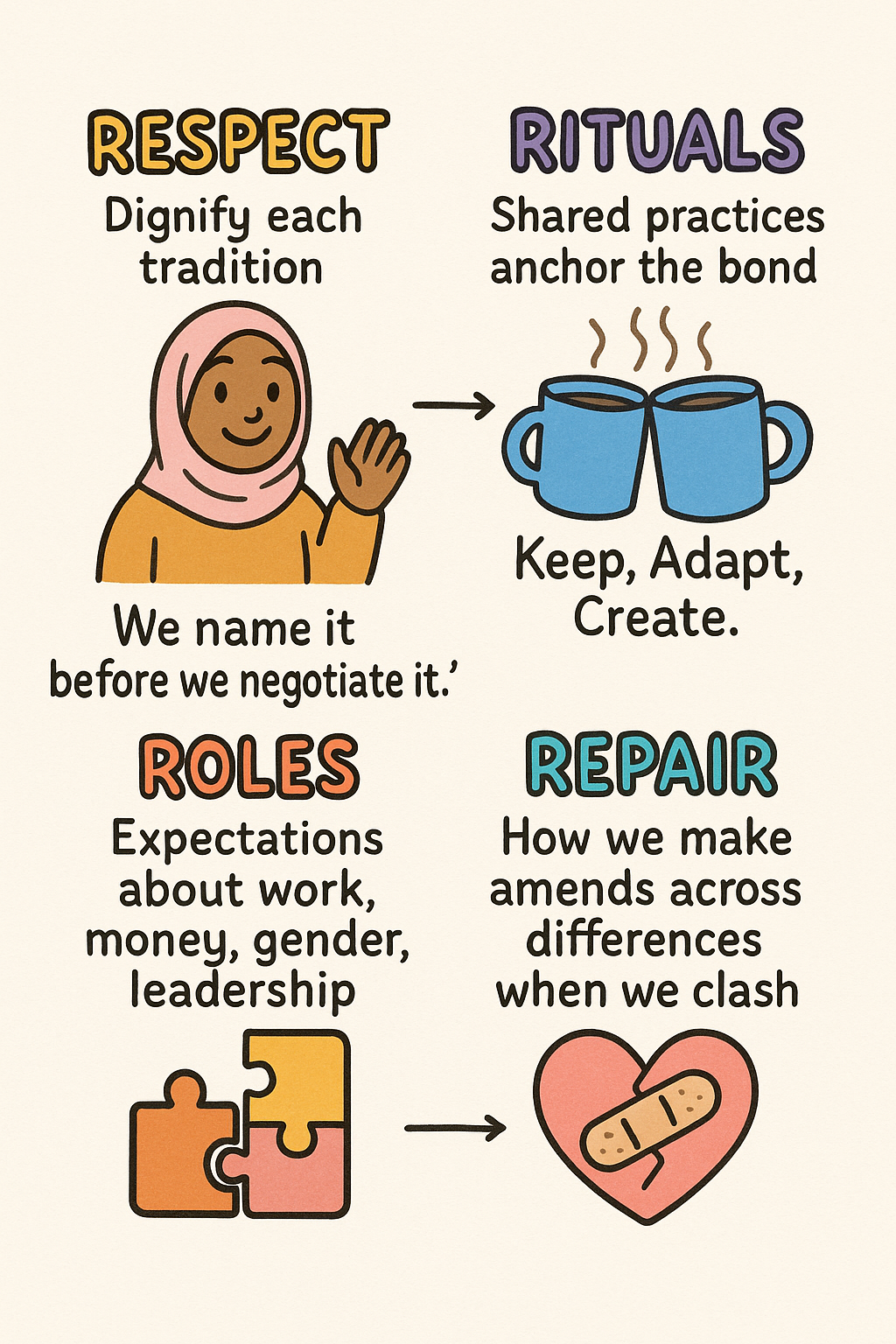
Respect
First we honor the story. I ask each partner to name what their elders taught about marriage, money, intimacy, and God. When couples feel seen, hard talks get easier.
Mary’s tip: Use “I honor… and I ask…” For example: “I honor how your family shows respect to elders, and I ask that we set a heads-up rule before big decisions.”
Rituals
Rituals are glue. Weekly dinners, blessings, or calls to parents keep care in motion. Research links meaningful family rituals with higher satisfaction in couples.
Mary’s tip: Keep one ritual from each tradition this month. Add one that’s “ours.”
Roles
Each tradition hands down assumptions about who earns, who plans holidays, who handles the budget, and who leads prayer. Roles can be flexible. Most friction shows up here.
Mary’s tip: Draft a role map for home, money, faith, and kin. Tag each role: me, you, shared, outsource.
Repair
All couples fight. In intercultural and interfaith pairs, the style of conflict can differ: one wants direct talk now, the other needs a pause. The skills that help most are naming the rulebook, asking for the translation, and making a small, fair trade. Evidence across modalities — EFT and behavioral approaches — supports structured repair skills for happier bonds.
Mary’s tip: After a flare-up, ask, “What rule did I step on?” then offer one concrete fix for next time.
Two Common Cultural Dimensions
- Individualism–Collectivism: Autonomy vs. kinship obligations
Some families prize personal choice; others prize duty to the group. Neither is “better.” It changes how you decide where to live, how money moves to elders, and how you set boundaries.
- Tight–Loose Cultures: Rule-bounded vs. flexible norms
“Tight” cultures prefer clear rules and lower tolerance for rule-breaking; “loose” cultures allow more leeway. This shows up in punctuality, dress, and conflict rules. In couples, tight-loose gaps often fuel fights about “the right way.”
What’s Universal, What’s Particular
Universal Needs
Across marriages I see the same core needs: safety, respect, fairness, shared meaning, and a secure bond.
Particular Expressions
Traditions express those needs in different ways:
- Commitment: A Catholic may see marriage as a sacrament; a Protestant may stress covenant promises; a secular couple may stress mutual vows and law.
- Sexual ethics: Rules differ on timing, privacy, and purpose.
- Finances: Some families pool; others keep accounts separate, with strong remittance duties to parents.
- Parenting: Views on obedience vs. voice differ across individualist/collectivist lines.
- In-law ties: In Chinese-influenced settings, filial piety can pull decisions toward elders; the couple must plan privacy with care.
Same needs; distinct codes.
How Major Religions Frame Marriage (900–1,100 words)
Note: Each tradition has wide variety. The sketches below aim for respect and accuracy.
Christianity (varied denominations)
Covenant vs. sacrament; divorce views; gender roles.
Catholic teaching holds marriage between baptized persons as a sacrament and a covenant; consent and indissolubility are central, with annulment as a path in specific cases. Many Protestants frame marriage as a covenant and a divine calling rather than a sacrament, with broader acceptance of civil divorce depending on denomination.
Rituals.
Common elements include vows before God and the community; in some churches, Communion during the service; faith community support after the wedding.
Mary’s tip — doctrine differences:
Name your “non-negotiables” and your “flexibles.” If one partner needs church vows and the other is uneasy, consider a church rite plus a private reading or song from the other tradition during the reception. Respect first, then creativity.
Islam
Nikah, mahr, and family involvement.
In Islam, a nikah is a binding marriage contract. The mahr (dower) is the bride’s right, symbolizing respect and financial security. Family often plays a role in match and support, though practice varies by region and school.
Divorce pathways.
Routes include talaq (husband-initiated repudiation, with rules and waiting periods), khulʿ (a wife-initiated contractual release, often with compensation), and judicial dissolution for defined harms, with variation across legal schools and modern states.
Case vignette — extended-family expectations:
Amina and Farid loved each other but fought about weekend plans. His mother expected weekly lunches; Amina wanted two Sundays per month free for couple time. We used the 4Rs:
- Respect: Amina thanked Farid’s mother for her care after Amina’s surgery.
- Rituals: We set the first Sunday for lunch with parents, third Sunday for friends.
- Roles: Farid took the lead on parent updates; Amina led the shared calendar.
- Repair: When a clash popped up, they used a “two yeses” rule: no added event unless both say yes.
Judaism
A ketubah is an Aramaic contract that outlines the husband’s obligations and protects the wife’s rights; the ceremony often takes place under a chuppah. Weekly Shabbat can set a natural rhythm for rest and reconnection. A get (religious divorce) is needed for a full religious dissolution; lack of a get can create hardship for a spouse, a problem known as agunot in some communities. Practices and reforms vary across movements.
Mary’s tip — weekly rituals:
Pick one short Shabbat-style pause each week. Light a candle, say one gratitude, share one request for the week ahead.
Hindu Traditions
Vivaha samskara; arranged/self-choice; joint family dynamics.
Hindu marriage is a samskara (sacrament/rite of passage) in many traditions. Families may arrange matches or support self-choice; joint family life can shape finances and care for elders.
Rituals.
Saptapadi — seven steps or seven rounds around a sacred fire with vows — often marks completion of the marriage in many regions, with local variations.
Vignette — household roles:
Ajay worked late; Mira felt alone managing dinner with his parents. We drew a role map: Mira chose groceries and meal plan; Ajay handled dishes and elder meds. They set two “no-company” weeknights to rest.
Buddhist Contexts
In many Buddhist contexts, marriage is viewed as a social contract under civil law rather than a sacred sacrament. Couples often draw on mindfulness, compassion, and non-attachment to ease conflict and lower harsh blame.
Mary’s tip — mindful de-escalation:
Two breaths in, four out. Name one feeling, one need, one small request. Pause for a sip of water.
Sikhism
Anand Karaj is the Sikh wedding ceremony held before the Guru Granth Sahib, with laavan hymns. The Sikh Rehat Maryada sets guidance for conduct; many gurdwaras require both partners to be Sikh for Anand Karaj, while some offer other forms of blessing or ask couples to do a civil wedding first. Ideals stress mutual dignity and seva — service.
Confucian/Chinese Cultural Patterns (non-theistic emphasis)
Filial piety, ancestral duties, face/harmony in conflict.
In many families shaped by Confucian values, filial piety and obligations to parents carry real weight. Couples often balance couple privacy with respect for elders and attention to “face” (public dignity).
Vignette — privacy and filial duty:
Li wished for weekly date nights; Chen felt torn if his mother needed help. They set a “door-in/door-out” plan: Friday night is theirs unless a medical need arises; Saturday afternoon is for parents, with a standing video call mid-week.
Culture Beyond Religion: Regional Patterns
Different parts of the world have their own ways of living and thinking, shaped by history and daily life. These differences affect how couples talk, handle money, and connect with family. Learning about these patterns helps partners understand each other and work together better.
East Asia
Strong pull toward harmony and elder duty; indirect speech often softens hard news. Couples plan how to show respect without losing couple privacy.
Myth vs. Fact:
Myth: “Indirect talk hides the truth.”
Fact: It can show care for face and still tell the truth with timing and tone.
South Asia
Dense kin networks; marriage often ties families as well as spouses. Money talks can include dowry history or bridewealth debates; handle with care and current law. Saptapadi and joint family norms may shape daily life.
Myth vs. Fact:
Myth: “Arranged means no love.”
Fact: Many couples report high support from kin once the match is made.
Middle East/North Africa
Honor/hospitality norms, varied across urban and rural life; Islamic personal-status law shapes contracts and divorce paths, with wide national variation.
Myth vs. Fact:
Myth: “All families are strict.”
Fact: Practices range from tight to flexible, even inside one city.
Sub-Saharan Africa
Bridewealth/lobola may formalize bonds between families; research notes complex effects on timing of marriage and women’s autonomy, with wide diversity across groups.
Myth vs. Fact:
Myth: “Bridewealth buys a wife.”
Fact: In many settings it marks ties between families; debates continue about equity and law.
Latin America
Familismo stresses loyalty and mutual duty; gender scripts like machismo/marianismo show up in some homes, while many couples choose more equal roles.
Myth vs. Fact:
Myth: “Machismo rules all homes.”
Fact: Data and lived stories show wide range, with many men and women choosing fair, warm teamwork.
Western Europe/North America
High personal choice and egalitarian ideals; the upside is freedom, the downside can be decision overload. Many couples benefit from simple rituals and clear money rules.
In the Therapy Room: Patterns I See in Intercultural & Interfaith Couples
From years of helping couples with different cultures or faiths, I see common issues that come up. These differences, tied to deep values, can cause confusion. By spotting these patterns and small clashes, couples can talk better, set clear limits, and value each other’s ways.
Frequent friction points:
- Money to parents vs. savings at home
- Holidays and holy days
- Gender role expectations
- Frequency and style of intimacy
- Conflict style: direct vs. indirect; fast vs. slow
- In-law boundaries and visits
- Parenting rules: obedience vs. negotiation
- Time: punctual vs. flexible; plan-ahead vs. spontaneous
Micro-mismatches: what it looks like / what it means
- “You didn’t text my mother back” / Respect to elders must be prompt
- “Why do we need a budget meeting?” / Money is moral order, not just math
- “We can’t move date night for your cousin’s drop-in” / Kin ties outrank couple plans
- “You raised your voice” / Strong tone equals honesty, not attack
- “You went silent” / Pause equals respect, not distance
- “Why cash gifts?” / Gifts may carry honor for elders
- “Why can’t our child sleep at Grandma’s?” / Family care equals safety and trust
- “No shoes at home?” / Cleanliness equals respect
- “Why no public affection at your parents’ house?” / Modesty equals dignity
- “You asked your dad about our budget” / Kin counsel equals wisdom, not control
Three Composite Vignettes (names and details changed)
A. Interfaith with family pressure
Sara (Catholic) and Omar (Muslim) loved each other, yet every holiday turned into a tug-of-war. Her parents wanted Mass; his parents wanted Eid with cousins. We used the 4Rs.
- Respect: “Your holidays hold your people.”
- Rituals: Calendar with Keep, Adapt, Create: keep Christmas Eve Mass; adapt Eid feast to Saturday; create a new “family soup night” the first Sunday monthly.
- Roles: Each leads invites for their own holidays.
- Repair: When voices rose, they used a 30-minute pause, then shared one acknowledgment and one ask.
Outcome: Both families saw effort; the couple felt like a team.
B. Diaspora couple, conflict language
Akiko preferred indirect, soft speech; James pushed for blunt talk. They kept misreading each other. We named the tight-loose gap. They agreed to signals: if Akiko said “Too fast,” James slowed; if James said “I need clear,” Akiko offered one direct sentence. Fights got shorter.
C. Holiday merge
Maya (Reform Jewish) and Theo (secular Greek Orthodox background) felt lost from October to January. We laid out a sample month schedule and a ritual map. They kept Shabbat dinner every Friday, adapted a Hanukkah night with Theo’s family recipe, and created a no-gift “service day” once in December. Peace returned.
Research Corner: What the Evidence Suggests
This part shares facts from studies on mixed marriages and family habits. The data points out common trends and ways to handle them.
- Interfaith marriages persist at notable rates. In the U.S., about 26% of married adults report a spouse of another religion, with broad variation by group and age.
- Jewish intermarriage varies by denomination. Non-Orthodox intermarriage has been high in recent cohorts; community responses and supports differ.
- Family rituals relate to higher couple satisfaction. Studies link meaningful rituals to marital satisfaction and lower stress during early parenthood.
- Tight–loose and individualism–collectivism matter. These cultural dimensions shape conflict rules, duties to kin, and daily routines in couples.
- Couple therapy works when you practice repair. Meta-analyses support Emotionally Focused Therapy (EFT) and behavioral couple therapy for distress reduction and sustained gains.
Practical Tools You Can Use This Week (400–600 words)
Try these steps now to build your link. They offer questions to talk about before you wed.
Before You Say “Yes”: Premarital Conversations
10 Questions Checklist (print and carry to dinner):
- What do our vows mean to each of us?
- Which weekly rituals stay from each home?
- What roles feel fair for housework and money?
- What financial duties to parents do we expect?
- Which holidays do we keep, which do we visit, which do we rotate?
- How do we set sexual ethics we both respect?
- What are our sacred lines — the no-cross zones?
- How will we raise kids with respect for both sides?
- How do we decide where to live if elders need care?
- Who mediates if we hit a wall?
When You Disagree: A Two-Step Repair Script
Script
- Step 1 — Name the rulebook: “In my family, X meant respect.”
- Step 2 — Ask for translation: “What did X mean in yours?”
- Offer a trade: “If we do A for your side, can we add B for mine?”
30-Minute Time-Out (tight/loose helper).
- Set a timer for 30 minutes.
- No texts to score points.
- On return, each gives one regret and one request.
- End with a next-step you both can do this week.
Mary’s tip on pacing and tone: Slow speech by one notch. Sit a bit closer than usual. Keep palms open.
Blending Rituals
Keep, Adapt, Create — Ritual Map
| Tradition | Keep (as is) | Adapt (tweak) | Create (new) |
| Yours | — | — | — |
| Partner’s | — | — | — |
| Ours | — | — | — |
Holiday calendar co-design (sample month).
- Week 1: Friday Shabbat dinner; Sunday call to both moms.
- Week 2: Mosque/Church/Sangha visit with a friend; Tuesday budget chat.
- Week 3: Family lunch with parents; Saturday date night.
- Week 4: Quiet weekend; service activity for a cause you share.
In-Law Boundaries
“We” Statements + Door-in/Door-out Plan
- “We love Sunday lunches. We also need quiet time the first weekend monthly.”
- If a pop-in happens during couple time: “We’re resting now. We’ll stop by tomorrow at 4.”
Sample text/email language
- “Hi Dad, we set Fridays as our recharge night. We’ll call Saturday at 10 and plan next week then.”
Money & Meaning
Budget meeting agenda (30 minutes)
- Values: what matters this month?
- Numbers: income, fixed bills, saving, giving.
- Roles: who pays which bill, who tracks.
- Review: 10 minutes next Sunday to adjust.
Three fair models
- Equal shares: Same amount to joint costs.
- Proportional: Based on take-home pay.
- Pooled with allowance: Most funds together; small personal amounts separate.
FAQs
Is compromise the goal?
Yes, but not 50/50 every day. Trade by season. If Ramadan or Lent asks more this month, rebalance next month.
What if our families won’t bless our marriage?
Lower the stakes from “win” to “respect.” Offer clear plans for visits, holidays, and grandchild time. Keep a united front and a soft tone.
Can we raise kids in both traditions?
Many do. Kids need clear stories. Pick simple weekly and yearly rituals from both sides. Keep a shared moral language: kindness, honesty, service.
What if one of us is not religious?
That person can still honor the other’s sacred times. Name your own meaning-making habits — nature walks, volunteer days, poetry — and add them to the ritual map.
How do we handle sex rules that differ?
Talk values, not just rules. Agree on care, consent, privacy, and mutual joy. If doctrine is central for one of you, bring a wise clergy person or therapist to help.
Is therapy worth it for culture clashes?
Yes. Studies show structured couple therapy improves satisfaction; skills you practice in session help at home.
Conclusion: Choosing Each Other, On Purpose
Marriage in different cultures and religions asks for humility and skill, not perfection. When you learn each other’s languages — of faith, family, and place — you build a home that holds both histories. Start with one small tool this week: a 30-minute budget chat, a ritual you both enjoy, or a simple repair script after a tiff.
“You don’t have to choose between your histories. You can weave them.”
If you want help building your 4R plan or easing a tight-loose clash, book a consultation. We can draw a map that fits your home.
Notes & Sources
- Religious intermarriage rates (U.S.). Pew Research Center, Feb. 26, 2025. (Pew Research Center)
- Intermarriage across race/ethnicity (context). Pew short reads. (Pew Research Center)
- Tight vs. loose cultures. Gelfand et al., Science, 2011. (science.org)
- Individualism–collectivism reviews. Oxford Research Encyclopedia; measurement overview. (oxfordre.com)
- Rituals and marital satisfaction. Fiese et al. on religious holiday rituals; review on family rituals and well-being. (PubMed)
- Couple therapy evidence. Meta-analyses on EFT and behavioral couple therapy. (PubMed)
- Christian sacrament/covenant references. Catechism of the Catholic Church; Vatican texts. (vatican.va)
- Judaism (ketubah, chuppah, get/agunah). Britannica; ReformJudaism.org; Jewish Women’s Archive. (Encyclopedia Britannica)
- Islam (nikah, mahr, khulʿ, talaq). CourtHouse Library BC; Britannica; overview of divorce forms. (courthouselibrary.ca)
- Sikhism (Anand Karaj, Rehat Maryada). Sikh Rehat Maryada (PDF); community guidance. (gurunanakdarbar.net)