




If you’re curious about dating abroad, you’re not alone. I’ve worked with cross-border couples for 30+ years, and I’ve watched real love grow across time zones, accents, and rulebooks. The hard part isn’t distance. It’s fog. Clear habits cut risk and raise trust. In this guide I’ll share why dating across borders is so common now, what men and women tell me they want, the best ways to meet, simple do/don’t rules, and a mindset that keeps feelings steady while you stay safe. Bring a notebook. Small moves today pay off all year.
Why Dating Abroad Is So Popular in 2026
Interest isn’t a fad. It’s a set of real shifts in how people meet and how they build a life.
Bigger pool, better filters
Apps widened the room. You can sort by city, language, faith, and plans for marriage. U.S. data show solid use of online dating, and many adults still worry about safety—so habits matter more than hype.
Remote work and easy flights
Many jobs moved online. Couples split months between cities without quitting. That keeps early dating lighter and gives real-world time in both places.
Proof that online meeting works
Long-running research on how couples meet shows a steady rise in online introductions. The study series from Stanford (HCMST) tracks this shift over time
Late-life second chances
Divorce, widowhood, or a reset at 45, 55, or 65 send people back to the apps. Surveys note that older adults use online tools too, even while many feel cautious about safety.
Curiosity about culture—done with care
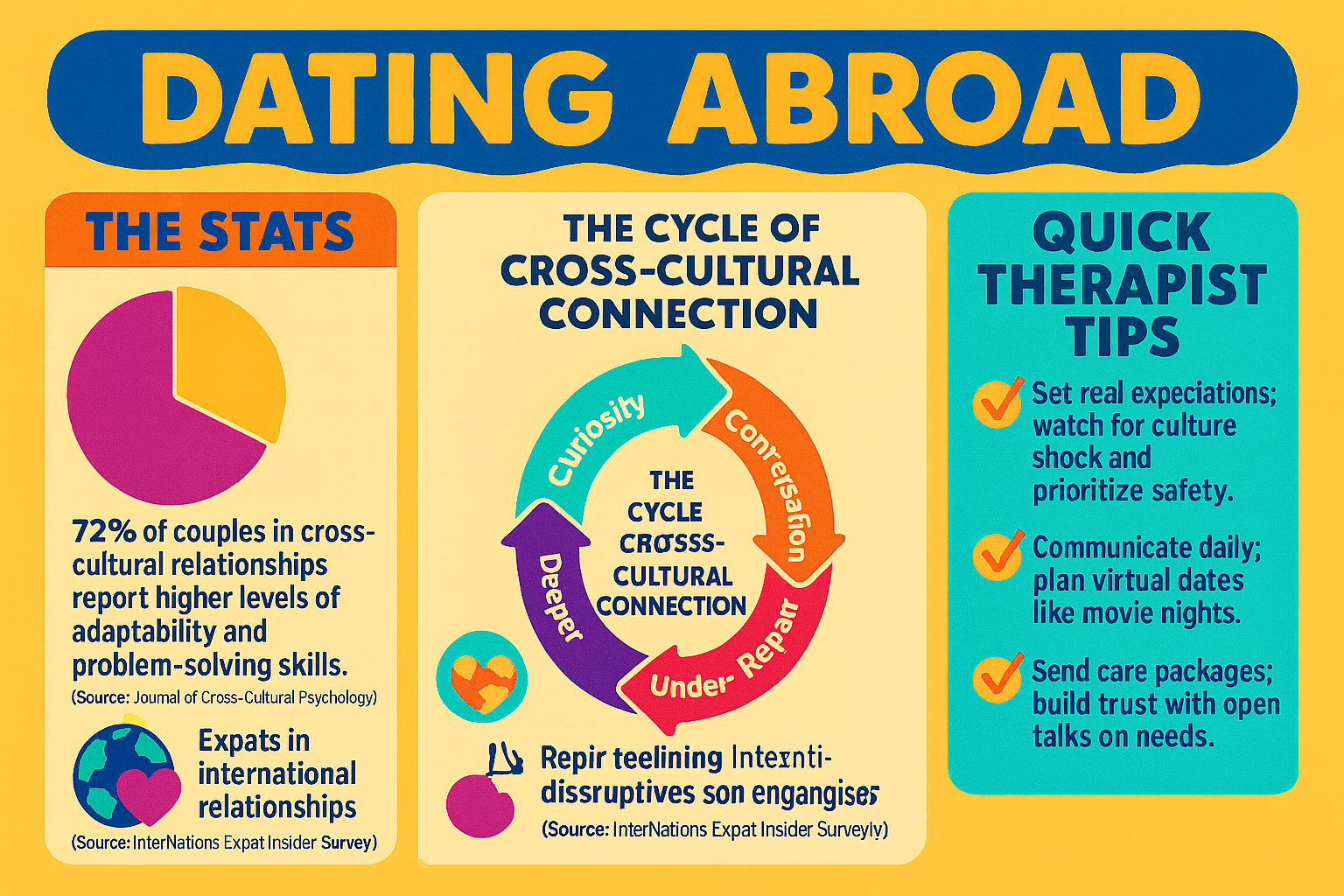
Many want a partner who shares values but grew up in a different place. Cross-cultural pairs often learn repair skills early and build strong rituals. Cultural “tight vs. loose” differences explain many clashes, which makes them easier to solve.
Why Some Men Seek Foreign Wives
When men tell me why they look abroad, I hear themes more than tropes. Here are the most common—without stereotypes.
- Clear wish for marriage and kids.
- Value on faith or weekly ritual.
- Hope for bilingual home and closer ties to elders abroad.
- Work or family roots in another country.
- Small local dating pool after divorce.
- Desire for steady roles with fair teamwork.
- Interest in shared frugality and long-term plans.
- A wish to live outside their passport country for a while.
- Strong interest in family-friendly towns rather than big-city scenes.
- A feeling that online tools open real options fast.
Mary’s reminder: “Ask for what you want, and listen just as hard.”
(If you meet through a broker, read the IMBRA rules first so safety stays front and center.)
Why Some Women Seek Foreign Husbands
Women in my office share practical reasons too. Not fairy tales—life plans.
- Clear intent for marriage within a year or two if it fits.
- A partner who names money, family, and faith early.
- Chance to live where jobs or schools align with plans.
- Respect for her career and her kin duties.
- Honest talk about children, step-children, or no kids.
- Desire for steady roles with equal say.
- A man open to her language and ritual.
- Calm conflict style and real repair skills.
- Strong safety plan on first meets and travel days.
- Willingness to meet her friends and elders.
“A woman on a site is not a product. She is a peer with a rulebook for respect.”
The Most Popular Ways to Date Abroad
The most reliable path today is international dating sites and apps with real moderation and clear reporting tools. You can sort for location, life stage, and plans. Move to a short video call within two weeks, then plan a public meet. Many adults worry about safety online, so standard rules help: no money, public places, separate rides.
Other useful paths:
- Language exchanges and alumni groups. Real conversation, low pressure, easy group time.
- Faith communities and community classes. Weekly rhythm builds trust.
- Volunteer teams with tasks. Service shows character fast.
- Work trips and remote-worker hubs. Co-working spaces host mixers and short talks.
- Local embassy or consulate culture nights. Museum tours, film screenings, holiday events.
Safety note: romance scams and app-related crimes do exist; losses reported to the FBI’s IC3 topped $16B in 2024 across internet crimes, with romance fraud a persistent slice. Use video, keep meets public, report pressure to send money. State and embassy pages publish scam alerts and practical tips for U.S. travelers abroad.
The Psychology of Cross-Border Relationships
Well-matched cross-border pairs can do very well. Why? First, curiosity beats correctness. You ask “What does this mean in your family?” before you judge. That lowers blame and speeds repair.
Second, culture is a code, not a verdict. “Tight” cultures prize strong rules; “loose” cultures prize flexibility. Once couples name where each partner sits, many fights shrink. You move one notch toward each other on time, rules, or conflict tone.
Third, rituals glue you together. A Friday candle. A Sunday call to moms. Research in family psychology links rituals with better marital satisfaction. Small and steady wins.
Fourth, skills beat stereotypes. Couple-therapy reviews show strong results for structured methods—good news for any pair that wants coaching, not guessing.
“Love doesn’t need magic. It needs rhythm, fairness, and a few scripts you both trust.”
What To Do—and What Not To Do—When Dating Abroad
Post these next to your calendar. Keep the tone kind and firm.
Do:
- Move to video early.
- Meet in public by day; separate rides.
- Tell a friend your plan; set check-in times.
- Keep money off the table.
- Use a shared calendar for visits and calls.
- Learn please/thank you in your partner’s language.
- Name your pace on intimacy and legal steps.
- Write two rules on fidelity: sex and secrecy.
- Keep one weekly ritual; protect it.
- Save receipts and copies of forms in one folder.
Don’t:
- Don’t skip video.
- Don’t meet in private on trip one.
- Don’t send money, crypto, or gift cards.
- Don’t use secret trackers or hidden cams.
- Don’t pressure for speed.
- Don’t compare partners to “people from X country.”
- Don’t hide kids, debts, or health issues.
- Don’t use immigration as leverage.
- Don’t fight late at night.
- Don’t go it alone; ask for help fast.
Safety help: report scams to IC3, and read State’s travel scam page before you fly.
Beyond the Honeymoon Postcard: Seeing the Real Person, Not the Stereotype
In my 30 years of practice, I’ve seen that we often fall for an idea of a culture. The real connection begins when you become curious about the individual behind the cultural archetype.
Why this matters? When you’re dating abroad, it’s easy to chase a postcard—“Italian passion,” “Nordic calm,” “Latin warmth.” Postcards sell. People breathe. The shift from “What are people from X like?” to “Who are you?” lowers fights and raises trust. Use these questions to move from myth to person.
Identity & meaning
- What parts of your hometown feel like “home” inside you now?
- If life goes well in ten years, what story do you hope we tell?
- When you say “respect,” what actions do you picture?
Family & loyalty
- Who counts as family in your week—parents, cousins, godparents, friends?
- How do you show care for elders or nieces and nephews?
- What would feel like a fair holiday plan between our families?
Daily life & money
- What makes a weekday feel decent—meals, quiet, humor, prayer?
- What money rules feel fair—equal share, proportional share, pooled with allowances?
- What is one non-negotiable value for our home?
Roles & privacy
- What chores or roles do you actually like? What do you dislike but will do?
- What counts as privacy to you—phone, diary, old friends, faith?
- How much “together time” vs. “solo time” keeps you steady?
Conflict & repair
- What raised voices meant in your house as a kid. Safe or scary?
- After a fight, what apology lands for you—words, action, touch?
- What would a kind time-out look like in our home?
Sex & affection
- What helps desire rise—humor, planning, surprise, rest?
- What makes affection feel safe in public? What feels off limits?
- If we hit a dry spell, what is a fair plan to reset?
Tip: Write answers down. Circle three lines you want your partner to remember this month. Trade circles.
Lost in Translation? It’s Not Just About Language
The most challenging translations aren’t of words, but of concepts. What one person defines as ‘respect’ or ‘support’ can look entirely different to another. This is where misunderstandings truly live.
The big idea. When couples date abroad, words match yet meanings split. “Soon” can mean five minutes or next week. “Respect” can mean quiet or blunt truth. Use this map to spot the gap and build a bridge.
| Friction point | Often looks like | Often means | Bridge move |
| Direct vs. indirect speech | One says “No.” The other hints. | Truth vs. harmony | Agree on a “soft-direct” line: “I want this, not that.” |
| Time & punctuality | One arrives early. One runs late. | Order vs. flexibility | Set a buffer: “Plan 12:45 for a 1:00 start.” |
| Respect | Quiet partner vs. debating partner | Polite vs. engaged debate | Choose context: quiet at dinner, debate on walks. |
| Family duty | Weekly parent calls vs. “private couple” | Kin first vs. couple first | Put calls on the calendar; protect one “us-only” night. |
| Public affection | Hand-holding vs. hands off | Warm pride vs. modesty | Pick zones for touch; vote with comfort. |
| Money talk | Up-front budgets vs. “We’ll see” | Safety vs. superstition or shame | Use a 20-minute budget huddle, same time each month. |
| Gifts & hosting | Big gifts, long visits | Honor vs. strain | Cap budgets and visit length; write a guest plan. |
| Apology style | “I’m sorry” vs. problem-solving | Words vs. fixes | Use both: one regret, one repair step. |
Two scripts to keep handy
- Translation ask: “When you say respect, what do you picture me doing or not doing?”
- Repair reset: “I may have used my rulebook. Teach me yours. Here is what I can try next time.”
Tip: Make a one-page “House Glossary.” Define five hot words—respect, support, privacy, family, late. Post it on the fridge for Month One.
When Your Family Is the “Foreign Policy Committee”
You’re not just merging with a person; you’re merging with a family system. Managing expectations and fostering understanding between your family and your partner is a critical, often overlooked, skill.
Why families matter? For many, love is not two people alone. It is a small alliance with two ministries of culture on each side. That can help or hurt. A plan lowers drama.
A. Warm introduction playbook (step-by-step):
- Pre-brief your partner. Tell two strengths and two stress points about your family.
- Pre-brief your family. Share three facts about your partner that will land well—hard worker, helps neighbors, honors elders.
- Pick a soft first setting. Tea at home or a short lunch, not a packed holiday.
- Script a shared origin story. “We met on a language app. We both wanted clear goals.”
- Set a time cap. Ninety minutes, ease in.
- Name a safe topic list. Food, travel, hobbies. Avoid hot politics on day one.
- Exit well. “We loved this. Let’s plan a short walk next time.”
B. Short scripts for a skeptical parent:
- You to parent: “I hear that you worry. I do too at times. I will go slow and keep you in the loop. Please meet them and form your own view.”
- You to partner: “My family tests new people. It is not a verdict. I will not leave you alone with hot questions.”
- You to both, in the room: “Can we start with stories from each hometown and save big questions for next month?”
C. Boundary templates:
- Curious, not rude: “We’re happy to answer most questions. We skip past salaries and past relationships today.”
- Visit limits: “Sunday dinner works. Sleepovers do not right now.”
- Religious asks: “We’re glad to attend. We will sit in the back and watch first.”
D. Debrief after the visit:
- One gratitude for a family member.
- One hard moment, named without blame.
- One plan for next time—shorter, earlier, or with a shared activity.
Tip: Treat each meeting as a pilot. Small wins quiet a “committee” faster than speeches.
The Question: Are We a Good Couple, or Just a Good Story?
Finally, I guide my clients to ask themselves this crucial question. The excitement of an international romance is powerful. You must discern if your bond is built on a shared foundation of core values and mutual respect, or simply on the allure of the exotic.
How to test the fit? A thrilling first act can mask weak basics. Use this field kit to see what you have. No rush, no panic—just light.
A. Five-minute scorecard (0–2 each; 10 points solid, 7–9 workable, ≤6 needs attention)
- We can state the same goal for the next 12 months.
- We agree on a fair money model and a review date.
- We keep one weekly ritual without reminders.
- We can fight without insults and use a set repair script.
- Both feel safe to say “not yet” on sex, travel, or legal steps.
Add it up. A low score is a signal for coaching, not shame.
B. The “Reality Swap” test
- Your life in their city: Could you picture a year there—jobs, friends, health care?
- Their life in your city: Could they picture a year—language class, transit, faith space?
- Joint plan: Name one relief valve for each side—regular calls home, budget for visits, a mentor.
C. Green flags vs. glitter
Green flags
- Matching pace, no sulking.
- Clear “no money” rule until public visits.
- Real friends and family on screen, not ghosts.
- Honest talk about kids, faith, and work.
Glitter that fools
- Grand words with no calendar dates.
- Big gifts on day three.
- Secrets “for your own good.”
- “People from my country always…” lines.
D. One-week experiment to ground the story
- Day 1: Write two fidelity lines—sex and secrecy.
- Day 3: Plan a mini-date you can repeat weekly.
- Day 5: Money huddle—values, numbers, roles, review date.
- Day 7: Conflict drill—time-out and repair script on a mild topic.
If this feels calm, you likely have a base. If this feels impossible, you likely have a story that needs a slower pace or a new plan.
Dating abroad should feel like two humans building one small, honest life. If the plot shines yet the habits fail, believe the habits.
Conclusion
Dating abroad works best with clear rules and a warm tone. Ask simple questions, set a steady pace, and keep first meets in public. Write two house rules on fidelity, set one weekly ritual, and use a short repair script after a tiff. Curiosity and fairness do more for love than any passport label.
Want a simple, four-week plan for your cross-border dating life? Book a consultation. I’ll help you set guard rails, build rituals, and keep the spark safe while you move toward a real future.
FAQs
Are apps safe for dating abroad?
Safer with video first, public meets, and a strict “no money” rule. The FBI reports record internet-crime losses in 2024; keep proof and report pressure fast.
Do online matches last?
Plenty do. How couples meet has shifted toward online over time; what matters most is how you treat each other after hello. See the HCMST series for trends.
Should I use a marriage broker?
I don’t advise it. If you ever do, read IMBRA and the U.S. government pamphlet on rights and safety. Mainstream platforms with moderation are usually better.
What skills help cross-border couples most?
Rituals, clear money plans, and short repair scripts. Couple-therapy reviews in the 2020s show strong evidence for structured approaches.
Any tips for safety while traveling?
Yes: use public spots, tell a friend your plan, avoid isolated areas from dating apps, watch for local scam patterns listed by State and U.S. embassies.
Sources & Links
- Pew Research Center. Key findings about online dating in the U.S. (use/safety views). (Pew Research Center)
- Pew Research Center. Older Americans and online dating (50+ usage). (Pew Research Center)
- Stanford How Couples Meet and Stay Together (HCMST) datasets and notes. (data.stanford.edu)
- FBI. Internet Crime Complaint Center (IC3) 2024 Report and press summary. (ic3.gov)
- U.S. State Department. Scams and safety for travelers. (U.S. Department of State)
- U.S. Embassy (Dominican Republic). Safety notice for using dating apps abroad. (do.usembassy.gov)
- Gelfand, M. et al. (2011). Tight vs. loose cultures. Science. (science.org)
- Lebow, J. (2022). Couple therapy in the 2020s: Current status and evidence. (PMC)