




Clients ask me, “What are the countries that love American men?” My answer is always the same: people fall for people, and context shapes the path. Some places feel warmer to Americans due to language, pop culture, or friendly norms toward newcomers. That does not mean guarantees or stereotypes; it means the odds of easy connection may rise. In this guide I’ll share the traits women tell me they value most, seven country contexts where Americans often feel welcome, what Americans say they like in foreign partners, and simple steps to meet well. Curiosity and respect do more than any passport ever will.
What Women Tell Me They Value Most in Men
Across 30+ years, I hear the same pillars from women in session, no matter the passport.
First, reliability. Show up when you say you will. Keep small promises. Reliability beats charm on hard days. Second, emotional steadiness. You do not need to be stoic; you do need to keep your voice low and your words clean during conflict.
Third, clear intent. Say if you want marriage, kids, or a long-term partnership. Women tell me mixed signals sap interest fast. Fourth, respect for her work and kin. Many women want room for their career and their family duties. That respect includes holidays, elder care, and weekly rituals.
Fifth, money clarity. It is not about income level; it is about fair rules and no secrets. Name your model—equal, proportional, or pooled with allowances—and set a monthly review. Sixth, kind humor. Lightness helps, but not at her expense.
Finally, repair skill. Fights happen. Can you say one regret and one request without blame? Women remember who calms the room when things go sideways. None of these traits require a nationality. They do, however, travel well across borders.
“You don’t need to be perfect. You need to be honest, steady, and kind,” I tell clients.
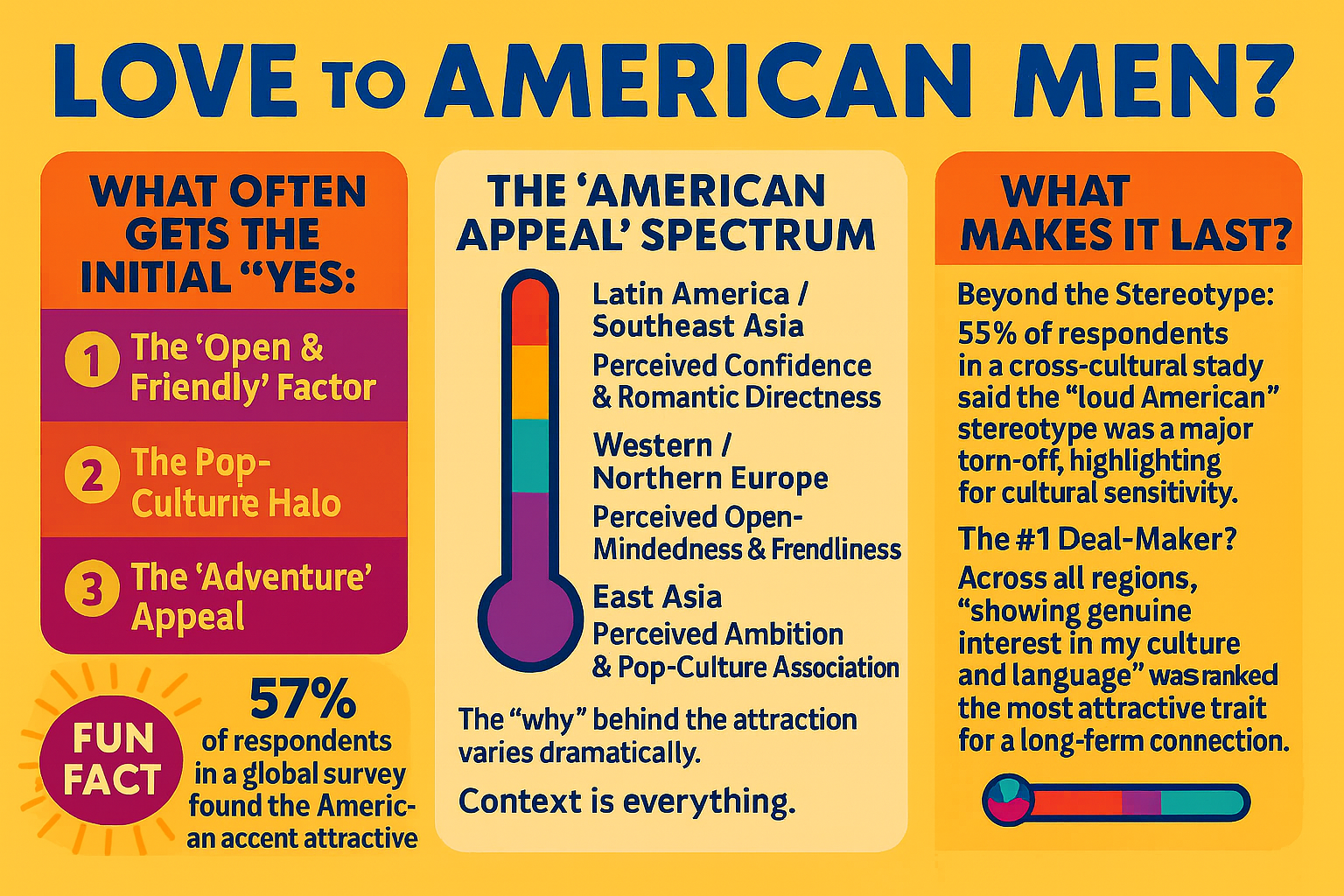
7 “Countries That Love American Men” — With Important Context
Quick note: There is no scientific list of countries that love American men. What we can point to: places where Americans report warm welcomes, where surveys show favorable views of the U.S., and where language or expat networks make daily life easier. Use this as a starting context, not a stereotype.
1) Israel
Pew’s 2025 global survey found the most favorable views of the U.S. in Israel (83% favorable). That positive stance often shows up in day-to-day warmth toward Americans, plus high English use in cities. Shared pop culture and long ties add ease for many couples.
Why this can help: similar media diet, frequent English, and social circles that already include Americans.
2) Poland
Poland posts solid favorable views of the U.S. in recent Pew data, and many Poles consume U.S. media and work with U.S. firms. Urban young adults often study English from school age, which lowers friction early.
Why this can help: pro-U.S. sentiment plus strong exposure to American culture.
3) Japan
Majorities in Japan view the U.S. favorably in 2024–2025 Pew snapshots. Add big-city English pockets and high U.S. pop-culture familiarity, and Americans often feel recognized even before they form local ties. Still, social norms on time, tone, and public affection deserve care.
Why this can help: cultural familiarity with U.S. media, interest in language exchange, shared urban hobbies.
4) South Korea
Pew shows majority favorable views of the U.S. here as well, and Seoul hosts large expat and study-abroad communities. Americans report fast social entry through language schools, gyms, gaming, and music scenes.
Why this can help: active expat hubs, high awareness of U.S. culture, many spaces to meet peers.
5) Brazil
Brazilians hold broadly favorable views of the U.S. in Pew’s 2024–2025 snapshots. Social life is lively, and many urban Brazilians speak English at a conversational level. Americans often meet friends through music, sports bars, and volunteer work.
Why this can help: positive U.S. image in surveys, open social settings, visible expat communities.
6) Mexico
InterNations ranks Mexico near the top for ease of settling in and local friendliness. That shows up as quick “welcome in” for many foreigners, including Americans—especially in mid-size cities with real neighborhoods. Use care not to rely on tourist bubbles; learn basic Spanish and give back locally.
Why this can help: friendly norms toward newcomers, short flights for long-distance pairs.
7) Philippines
InterNations also places the Philippines high for local friendliness, and English is widely used nationwide, which helps Americans build connection fast. Many expats say friendships come easily when you show respect for family ties and faith.
Why this can help: English use, warm reception to expats, shared online culture.
Therapist note: Favorable views of the U.S. or “friendly locals” scores do not guarantee interest in you. They simply lower early friction. A good match still depends on steady traits, not a flag.
Do Americans Love Foreign Women? What I See, Plus Data
Short answer: plenty do. Long answer: it varies by city, age, and goals. In national data, Americans meet partners online at rising rates, which widens cross-border and cross-culture matches. The Stanford HCMST study series tracks that shift from local setups toward online introductions over time.
On nativity mixing, hard counts exist but are scattered. A Census release found that in 2011, 21% of married-couple households had at least one foreign-born spouse. Later Census briefs show mixed-nativity marriages as a steady slice of current unions as well. The exact share moves with migration flows and local demographics, but the picture is common, not rare.
In my caseload, many U.S. men say they are drawn to women who hold clear family ties, show kindness with elders, and want steady roles with equal say. Many also like bilingual homes and the chance to live abroad for a season. American women report similar themes about foreign men—clear intent, respect, and fair money rules. None of this means “Americans love X nationality.” It means large, normal reasons shape cross-border choice.
One more lens: views of the U.S. in other countries tend to be more positive than negative in Pew’s global samples (median favorable 54% in 2024), which often eases first meets and social acceptance for Americans abroad. It helps; it is not destiny.
Top 5 Best Traits of American Guys (what clients praise)
Not every American man shows these. Many do, and women in my office say these five stand out.
1) Direct intent without the hard sell
Saying what you want—marriage, kids, timing—without pressure. Direct does not mean loud; it means clear and calm.
2) Shared chores as normal
Plenty of U.S. men see house work as team work. Doing dishes without fanfare feels “adult,” not heroic. That normalcy wins respect fast.
3) Comfort with coaching and therapy
Many are open to books, workshops, or a few sessions. Willingness to try tools signals humility and care. Reviews of couple-therapy models show strong gains when both show up ready to practice.
4) Rituals that stick
Sunday grocery runs, midweek check-ins, date night on a budget—small rhythm builds safety. Family-psychology research ties rituals to stronger satisfaction; this holds across cultures.
5) Respect for her goals
A widespread value I hear: “I want her career to breathe.” That respect shows up in calendar choices, childcare plans, and holiday trade-offs. It’s not universal; it is common enough to name.
Reminder: traits vary by person. Praise the behavior you like; don’t assume it comes standard with a passport.
Where to Meet Women Who Like Americans
The best path now is international dating sites and apps with real moderation and reporting tools. Move from text to video within two weeks so both of you meet a real person, not an idea. Plan a public first meet by day with separate rides and a friend who knows your plan. U.S. surveys show broad use of online dating, but mixed views on safety, so clear habits matter.
How to do it well, step by step:
- Pick platforms that show real profiles and allow quick video. Avoid “catalog” sites that treat women like products.
- Write a clean profile: one value you won’t bend on, one ordinary joy, three current photos.
- State pace: “Video in week one, public meet on trip one, no money asks.”
- Learn basics in her language; keep humor kind.
- Keep budgets separate; no wires, crypto, or gift cards. The FBI’s IC3 reports record internet-crime losses in 2024; romance fraud remains a problem. Report pressure fast.
- DM less, calendar more. A weekly video at the same time beats random late-night chats.
- After a good meet, build a 90-day plan: weekly video, monthly group hang, one shared ritual. Small and steady wins.
If you prefer offline, try language exchanges, alumni groups, service projects, and faith communities. Places with weekly rhythm beat loud bars for building trust.
The “Easy American” Paradox: Why Being Low-Effort Fails Abroad
I’ve seen men assume their nationality alone is enough. This ‘easy American’ approach—leading with clichés and showing no effort to learn the language or customs—is the fastest way to be dismissed as a short-term fling.
What gets you waved off vs. what earns respect
| Low-effort move | What she reads | High-impact move | What she feels |
| Only speaks English, louder, slower | “He expects the world to adjust to him.” | Learns 20 local phrases; tries them with a smile | “He meets me halfway.” |
| “In the States we do it better.” (food, lines, rules) | “Comparison as status play.” | “Teach me your way here—what’s polite?” | “He listens and adapts.” |
| Tourist bars, tourist friends, tourist jokes | “He wants a postcard, not a person.” | Local meetups, small cafes, community classes | “He wants a real life, not just a story.” |
| Fast compliments, faster pressure | “Short game.” | Clear intent + slow pace: “I’d like a second date next week.” | “Safe, steady interest.” |
| Treats tips and staff rudely | “He will treat me this way later.” | Thanks workers by name; learns the tipping norm | “Kindness is not a show.” |
| No calendar, no plan | “Chaos, then excuses.” | Sets a time, confirms the spot, arrives on time | “Reliability beats charm.” |
Micro-scripts that land well
- “May I try that in your language? Please help me if I say it wrong.”
- “How would someone local handle this?”
- “I like our pace. Next Wednesday works for me—does it work for you?”
One-week upgrade plan
- Day 1–2: learn greetings, numbers, please/thank you, and “How do you say…?”
- Day 3: pick a local news site or YouTube host; watch a short clip.
- Day 4: book a table at a small place she loves; arrive five minutes early.
- Day 5: ask one “teach me” question about city etiquette.
- Day 6: attend a language exchange or community class.
- Day 7: write a short message that sets the next plan, not just vibes.
The Long-Term Visa for the Heart: Are You a Good Fit for a Life, Not Just a Trip?
The romantic getaway is one thing; building a life is another. You must ask: Are my core values around career, gender roles, and family compatible with the societal fabric of her country? The fantasy crashes when reality’s paperwork begins.
Quick fit check (use a notebook; circle green/amber/red)
- Work-life balance. Her city may expect later dinners, longer commutes, or weekend family time. Can your job bend? Can you accept public holidays and shop hours that differ from home?
- Household roles. Who cooks, who cleans, who plans social life? Name likes and dislikes. Pick a fair split (equal, proportional, or pooled-with-allowances) and set a review date.
- Family duty. Weekly parent calls? Elder care? Big cousin network? Decide what “yes” looks like and where your quiet time lives.
- Kids or no kids. If you want kids, list public vs. private school costs, language plans, and citizenship admin. If you do not, write one line you both can stand behind with family pressure in the room.
- Faith and public norms. Dress, alcohol, public affection, and holiday rules vary. Can you respect local lines without resentment?
- Legal and visa load. Visas, taxes, health insurance, driver’s license swaps—these shape mood. Pick who leads which task and set a weekly “paperwork hour.”
Three tools to ground the dream
- Week-in-the-life trial. Map 7 days in her city: commute, meals, gym, errands, friend time. Do it on a trip, not from a sofa.
- Two-home plan. If both love your own countries, test a 6/6 split or a 9/3 split. Price flights and taxes; list what breaks first if money tightens.
- Deal-breaker map. Each writes three non-negotiables (faith practice, contact with parents, career track). If a line blocks the other’s life, say so now with a soft voice, not later with a hard fight.
Decision tree (very simple)
- Can we picture one year here without heavy strain? If no, try a split model.
- If the split model still strains both, press pause. Good love hates resentment.
- If the one-city plan feels calm after a trial, set a 90-day review and lock a ritual that protects couple time.
Reality check: the “visa for the heart” runs on calendars, chores, and tone. Romance breathes easy once those are clear.
Case Studies in Context: A Therapist’s Comparative Lens
Let’s move from theory to practice. Through my lens, let’s explore why the same American man might thrive in one context and struggle in another, based on the alignment of his personality with unspoken cultural rules.
Names and details changed; cities representative, not prescriptions.
John in Berlin vs. John in Manila
Berlin. John likes blunt talk, plans on paper, and quiet bars. Berlin rewards straight asks and punctual meets. He learns basic German, bikes to dates, and splits bills without fuss. Her friends value direct humor and clear lines; “What time?” means a time. His steady texts and on-time arrivals land as care, not control.
Manila. Same John opens with blunt sarcasm and fast pace. He teases on day two and pushes for direct answers in a room that values warm indirection. He talks over elders at a family lunch without meaning harm. Fix: slow tone, soften asks, honor family rhythm, learn three lines of Tagalog, and bring a small gift for the host. Once he adjusts, doors open.
Marcus in Tokyo vs. Marcus in São Paulo
Tokyo. Marcus loves silence, detail, and neat routines. Tokyo fits him. He respects lines on trains, keeps voice low, sends short, precise texts. He learns set phrases, watches for nonverbal cues, and lets trust build over weeks. His calm reads as safety.
São Paulo. He keeps the same quiet style at loud tables and gives one-word replies. Friends think he is bored. Dates stall. Fix: longer answers, warmer eye contact, and a light plan that adds music or street food. He stays himself, just turns the dial two clicks toward open.
Ethan in Warsaw vs. Ethan in Mexico City
Warsaw. Ethan values faith rhythms, Sunday meals, and tidy budgets. He fits right in with a partner whose family meets weekly. He brings pastries, helps clean, and learns two prayers in Polish. He feels at home.
Mexico City. He brings the same set of rules but treats every cousin ask as a test. He calls group time “intrusion.” Friction rises. Fix: a Door-In/Door-Out plan—yes to Sunday comida twice a month, couple-only Saturdays, and a monthly lunch with just parents.
Daniel in Tel Aviv vs. Daniel in Copenhagen
Tel Aviv. Daniel talks fast, loves debate, and leans playful in conflict. Lively dinners suit him. He gets a crash course in chutzpah and frank chats. He thrives once he respects Shabbat pace and learns not to text work stuff on Friday night.
Copenhagen. He keeps the same high volume and hot takes in a room that values quiet and consensus. Friends back away. Fix: shorter points, slower pace, and a habit of asking, “How would you solve this?” His humor still shines, just with softer edges.
Cole in Seoul vs. Cole in Naples
Seoul. Cole prizes hierarchy and clear rules at work. He respects age order, keeps dress sharp, and lets senior folks speak first. His date enjoys his care with elder respect and the way he learns honorifics.
Naples. Cole brings the same formal stance to a family that values warmth over titles. He seems stiff with her aunties, guards the schedule too tightly, and leaves gatherings early. Fix: greet every elder with full eye contact, help clear plates, and accept late laughs with grace.
Takeaway across pairs. The man didn’t change. The fit did. Culture sets the room tone. Two moves unlock most rooms: name the rulebook, then shift two degrees toward it without losing yourself. If you can’t shift, pick a city that loves your base settings or plan a split life that honors both.
Mini self-audit before you book the ticket
- Do I like loud tables or quiet corners?
- Do I like plans or flow?
- Do I value mixed-gender friend groups or single-sex hangouts?
- Do I handle big families with ease or with a fuse?
- Can I trade some comfort for her comfort on a weekly basis?
My line in session: “You don’t need a new you. You need a version of you that respects the room.”
Conclusion
Talking about countries that love American men can lead you into stereotypes. Use context as a map, not a verdict. Favorable views of the U.S., friendly norms toward newcomers, and easy English can help, but real love still comes down to reliability, respect, and steady repair. If you mean marriage, say so. If you want time, say that too. Clarity is kind.
Want a simple, four-week plan for cross-border dating done well? Book a consultation. We’ll set guard rails, build rituals, and keep the spark safe while you test real fit.
FAQs
Is there a scientific ranking of countries that love American men?
No. We can point to places with favorable views of the U.S. and high expat friendliness, but attraction is personal. Use data as context only.
Where do Americans most often meet foreign partners?
Online is common and rising over time, based on long-running studies of how couples meet. Safety habits matter more than the app you pick.
Do Americans often marry foreign-born spouses?
Yes, mixed-nativity marriages are a steady part of U.S. family life. A Census release found 21% of married-couple households had at least one foreign-born spouse in 2011; later briefs also show mixed-nativity unions in the mix.
Are international dating apps safe?
Safer with clear rules: video early, public meets, no money. The FBI reports record internet-crime losses in 2024 across crimes, with romance fraud a persistent slice.
Which single habit helps most across cultures?
Rituals. Keep one weekly ritual and a short repair script. Evidence backs structured tools in couple work.
Sources & Links
- Pew Research Center (2025). Views of the United States (country favorability list). (Pew Research Center)
- Pew Research Center (2024). Global views of the U.S. (median favorable across 34 countries). (Pew Research Center)
- InterNations Expat Insider 2024. Ease of Settling In Index (friendliness/local connections; Mexico, Philippines near top). (InterNations)
- U.S. Department of State. Visa Statistics (spousal and fiancé visa categories overview). (U.S. Embassy Travel Affairs)
- U.S. Census Bureau (2013). 21% of married-couple households had at least one foreign-born spouse (2011). (Census.gov)
- U.S. Census (2021 tip sheet). Mixed-nativity marriages share (current marriages). (Census.gov)
- Stanford HCMST: How Couples Meet and Stay Together (rise of online introductions). (Census.gov)
- FBI IC3 (2024). Internet Crime Report (record losses; romance fraud persists). (ef.edu)